

Building a Network that Believes
Bringing People into the Work of Change

This spring I had the privilege of visiting Oklahoma, where I got to spend time with an energized network of Teach For America educators, alumni, and community leaders. Across Oklahoma City and Greater Tulsa, 145 corps members and alumni have been named Teachers of the Year since 2009. Alumni are leading schools in partnership with their communities, like Elsie Urueta Pollock, the founder and CEO of Tulsa Honor Academy, where 100% of the 2025 graduating class was accepted into a four-year university. She does this alongside a dedicated teaching and leadership team that includes 18 TFA alumni, changing the trajectories of students like Camila Linares, who credits the school’s college readiness team with helping her access opportunities that would lead to earning a full-ride at Washington University in St. Louis.
These are powerful accolades. But they are not the story on their own.
The real story is what sits behind them: a broader ecosystem of educators, school systems, nonprofits, and community leaders working toward shared goals. Teach For America is one contributor within that effort.
What energized me most was seeing how that ecosystem is not just producing pockets of progress, but working intentionally to build belief, making progress visible and bringing more people into the work of change.
At the same time, this work is unfolding in a broader educational landscape shaped by real anxiety and doubt. Recent reporting from The 74 looks at how the state, ranked 48th in the country by NAEP scores, is seeking to improve student outcomes. Recent state assessments show that nearly three in four Oklahoma students are not proficient in reading. The concern that students are falling behind is both valid and widely shared, and in some places, it’s contributing to a deeper sense that meaningful progress may not be possible.
This tension is not unique to Oklahoma. Across the country, skepticism about what’s possible in education is growing.
Which raises a deeper question: in a moment like this, how do you build belief?
What I saw in Oklahoma suggests that belief is something you build, intentionally and collectively. In a landscape where what’s possible is too often underestimated, the TFA Oklahoma network is distinguishing itself through an evidence-based, trust-first model that expands who sees themselves as drivers of progress.
It can be hard to resist the magnetism of the status quo. Which is why, in deep partnership with alumni and local partners, TFA Oklahoma has spent the past five years steadily strengthening engagement, turning that momentum into accelerated outcomes for students, and elevating those bright spots to spark and spread belief.
What this Oklahoma coalition is building offers more than a set of local wins—it offers insight into how belief can be strengthened anywhere skepticism runs deep.
Cultivating the Conditions for Change
Belief doesn’t emerge by accident. It grows when a few key conditions are consistently present: people feel seen, progress is visible, and there is a clear path to act. In Oklahoma, those conditions are being deliberately built as an interconnected whole.
Through an approach grounded in trust, relationships, and evidence, the region continually invites educators and partners to see both how far the network has come toward its shared student achievement goals—and how much more is possible when more people engage. That clarity is fueling connection, alignment, and action across the network.
Relationships
It begins with one‑on‑one connections, a hallmark of community organizing that helps people feel seen, cared for, and motivated to come together around shared interests. In Oklahoma, this shows up in simple but powerful ways: team members meet alumni in their schools or offices—grounding conversations in the real work and witnessing impact firsthand. These visits signal respect for alumni’s continued commitment and make it easier to surface both needs and bright spots in context. (Pro tip from the Oklahoma team: in our virtual culture, Zoom is great for staying engaged, but re-engaging requires in-person connection.) By investing first in relationships through trust-building conversations that surface what their network cares about–with an emphasis on alumni still in schools–TFA Oklahoma is reconnecting their network to a shared purpose.
Across professions and community organizing, research shows that one-on-one engagements are critical for moving individuals to action. In Oklahoma, they are re-setting the foundation for everything that follows.
Community
These individual connections widen into community and shared identity. The region focuses on creating spaces for alumni and partners outside of the alumni network to come together, share experiences, and build a collective sense that Oklahoma is a place where change can take root. Through convenings and moments of shared learning centered on their collective goals, participation has grown steadily. In 2025, 35% of all statewide alumni attended the annual network convening, and more than half engaged in gatherings focused explicitly on progress toward 2030—up from just 18% five years earlier. As one member of the TFA Oklahoma team expertly put it, “How you cultivate hope is by not being alone.”
Shared Understanding of Success
This deepening engagement goes hand in hand with building a shared understanding of success grounded in student outcomes. By consistently anchoring conversations in evidence—what progress looks like, where gains are showing up, and where gaps remain—TFA Oklahoma’s network is developing a shared bar for success. Rather than asking alumni simply to believe change was possible, the region makes success visible and measurable, creating opportunities for reflection, learning, and alignment.
I saw this firsthand at Greater Tulsa’s Rise & Shine educational leadership breakfast, where corps members and alumni in the McLain High School feeder pattern shared how they are driving outcomes across classrooms and school leadership. Teachers and leaders pointed to student data, instructional practices, and concrete results—showing what progress looks like when high expectations are paired with support:
Brita Faerber (Greater Tulsa 2024) teaches geometry at McLain High School and co‑coaches debate and Academic Bowl, creating multiple, high‑expectation learning experiences for students.
Rob Kaiser (Greater Tulsa 2013), a former district teacher of the year, now serves as principal of McLain High School, which is making gains in ACT scores, family engagement, and extracurricular participation.
Marissa King (Phoenix 2008) leads the Teaching and Leading Initiative of Oklahoma, contributing to multiple elementary schools coming off the state’s F‑list and achieving historic student growth and performance.
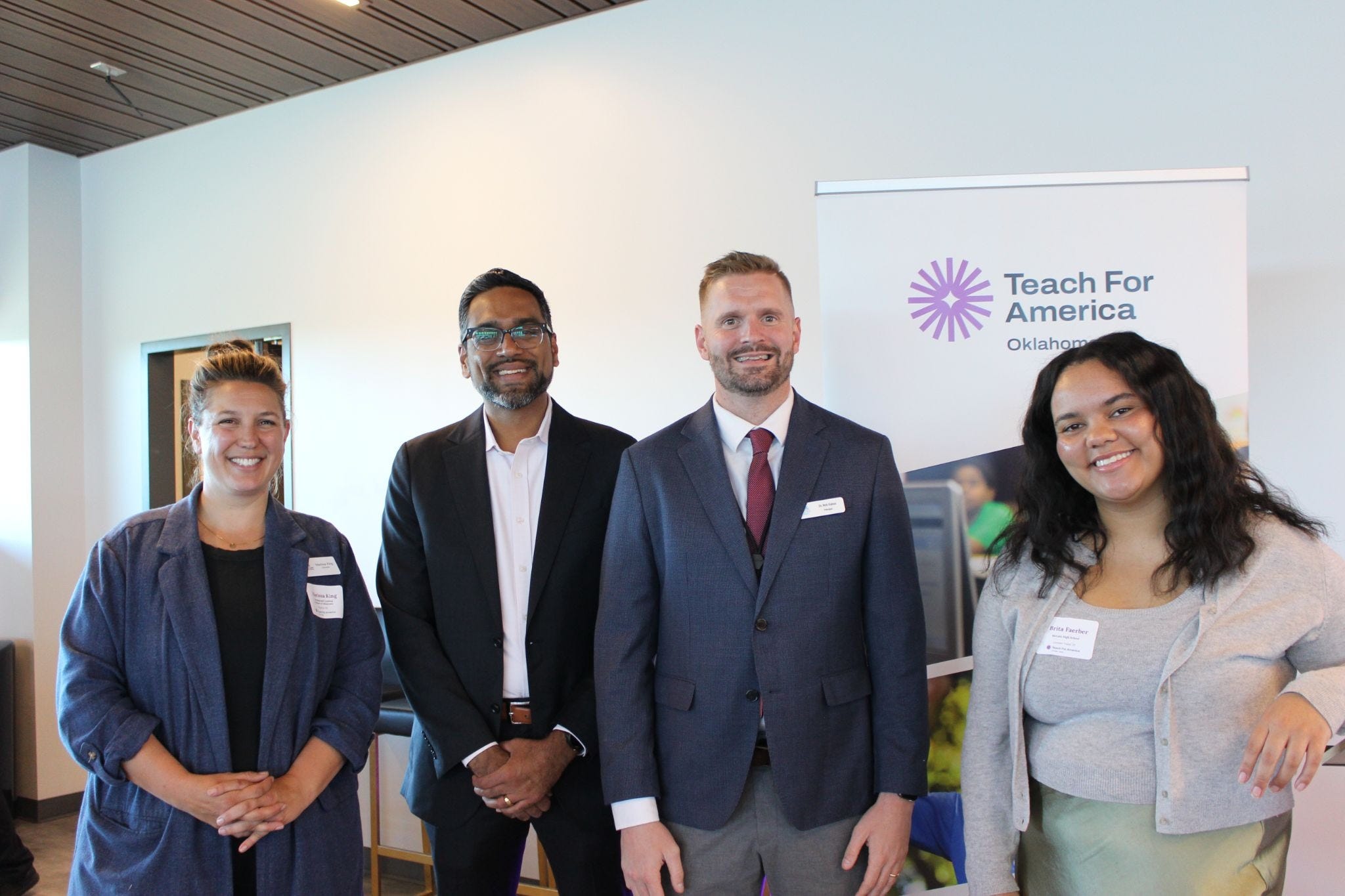
Left to Right: Marissa King (Phoenix 2008), Aneesh Sohoni (Twin Cities 2009), Rob Kaiser (Greater Tulsa 2013), Brita Faerber (Greater Tulsa 2024)
By spotlighting these examples, the region created space for learning through evidence, not judgment—helping alumni see themselves in the shared standard and learn from one another.
Culture
Sustaining this over time requires culture. Experienced educators and leaders help reinforce what the community stands for and what progress looks like in practice. They connect new educators to a broader network, ensuring that belief is not just individual, but shared and enduring.
One way TFA Oklahoma contributes to this is through what they call culture keepers. These are alumni and leaders who carry the network’s values, expectations, and sense of possibility across generations. By intentionally connecting new teachers to experienced alumni and the broader network, the region reinforces who belongs, what the community stands for, and what progress looks like in practice. This year alone, more than 60 alumni served as culture keepers in new teacher programming, helping embed belief in a way that feels supportive, accessible, and enduring.
Action
The region consistently helps educators translate belief into next steps, even when problems can feel intractable. These clear calls to actions are centered in every convening, giving the network tangible ways to put learning into practice for impact and improvement. For example, at a recent statewide gathering, TFA highlighted local school leaders who achieved incremental gains—such as improving school ratings from a C to a B—and walked through the specific steps that made that first bump possible. The session was so popular that registration was capped.
“I learned that people are craving the next step. We all are clear on the vision. We all have One Day in our heads, but how do you take the first step to get there so that it’s not just something inspiring, but it’s actually something you can replicate?”
–Parisa Pilehvar, Managing Director of Collective Leadership for TFA Oklahoma
Together, these conditions– relationships, community, shared understanding of success, culture, and action–form an integrated system for building belief. They strengthen schools from within and build shared ownership for student success across communities. And they show that when belief is grounded in evidence and nurtured collectively, it becomes one of the most powerful drivers of change.
Lessons for the Field
It can feel risky to ask educators to do more when they are already tired and contending with real pressures. But time and again, TFA Oklahoma has found that people feel more hopeful—not more overwhelmed—when they are given a clear next step to address a problem they care about. Even educators who are initially skeptical of the Teach For America network continue to return to regional events once they see that improvement is possible. The region intentionally stewards this group, replacing disbelief with evidence, momentum, and a path forward.
Perhaps the most powerful dimension of the collective’s work in Oklahoma is how it is shifting belief beyond schools themselves, drawing in civic and philanthropic leaders who may not have previously seen a clear path to impact.
In Oklahoma City, state legislators, members of the local school board, and school leaders attend TFA’s quarterly EduTalk series to learn about the leaders producing bright spots in student outcomes. In Tulsa, a partnership with a TFA alumnus helped shape Mayor Monroe Nichols’s bold 2030 goal to place 15,000 more children on a path to economic mobility and academic success. Across the state, alumni regularly meet with elected officials to exchange insights on where they see outstanding student achievement and what factors are contributing to these results.
What’s happening in Oklahoma is not about a single program or organization. It reflects a broader set of choices across an ecosystem: invest in relationships, make progress visible, build shared expectations, nurture the culture that is formed and offer clear next steps.
In a moment when disbelief can feel rational or even inevitable, the work is not to argue people into optimism. It’s to create the conditions where progress is undeniable and belief becomes unavoidable.
EXTRA CREDIT: I had the chance to catch up with Tulsa Honor Academy founder Elsie Urueta Pollock (St. Louis 2008), whom I got to know well while we were both Pahara Fellows. Hear what Elsie had to say about what makes the TFA Tulsa alumni community so special.